Heat Transfer Week 2
Heat Transfer Week 2
12 A Brief Review of Differential Equations terms
The science of thermodynamics deals with the amount of heat transfer as a system undergoes a process from one equilibrium state to another, whereas the science of heat transfer deals with the rate of heat transfer, which is the main quantity of interest in the design and evaluation of heat transfer equipment.
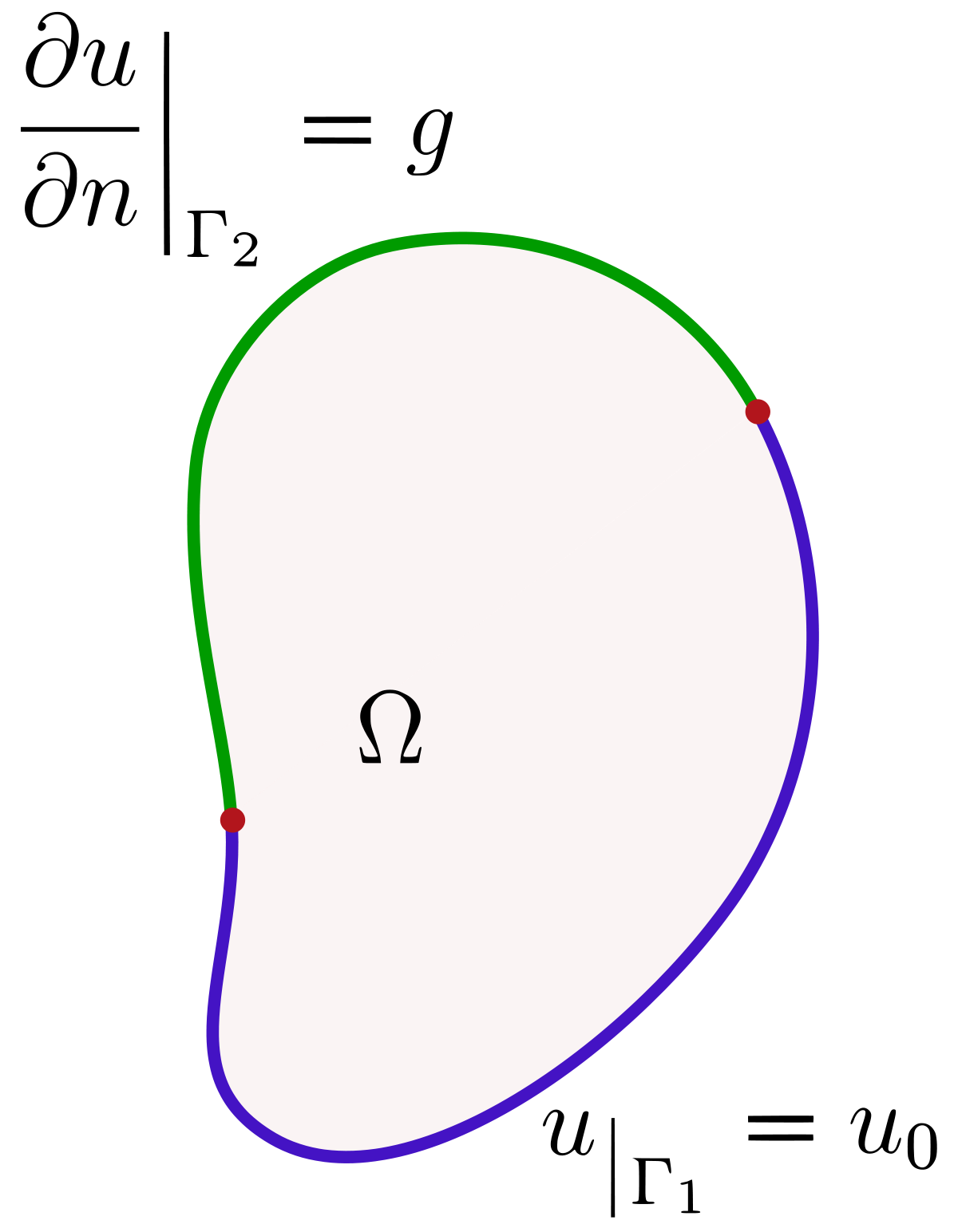
- Boundary conditions
- A boundary value problem is a differential equation (or system of differential equations) to be solved in a domain on whose boundary a set of conditions is known.
- Example: a stated restriction, usually in the form of an equation, that limits the possible solutions to a differential equation
- es: Condiciones iniciales
- Constant
- You use constant to describe something that happens all the time or is always there.
- Example: He has been her constant companion for the last four months.
- es: Constante

- Emissivity
- Emissivity is defined as the ratio of the energy radiated from a material's surface to that radiated from a perfect emitter, known as a blackbody, at the same temperature and wavelength and under the same viewing conditions.
- Example: a measure of the ability of a surface to radiate energy; the ratio of the radiant flux emitted per unit area to that emitted by a black body at the same temperature
- es: Emasividad
- Energy balance
- An energy balance is a consideration of the energy input, output, and consumption or generation in a process or stage.
- Example: In establishing an energy balance, all sources of thermal energy are put on the input side, and all items of heat utilization on the output side.
- es: Balance de energía
- Heat conduction equation
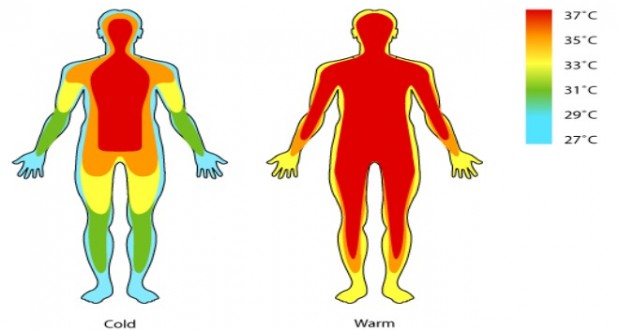
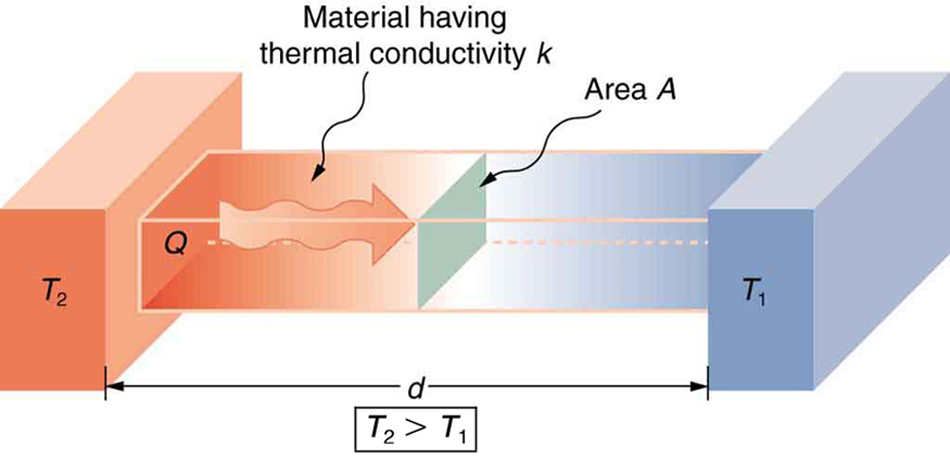
- The heat conduction or transfer of energy as heat by conduction is a process of heat transfer based on direct contact between the bodies , without exchange of matter , because heat flows from a larger body temperature to a lower temperature who is in contact with the first.
- Example: We have to solve the heat conduction equation from this house.
- es: Ecuación de conducción de temperatura
- Heat flux
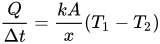
- Sometimes also referred to as heat flux density, heat-flow density or heat flow rate intensity is a flow of energy per unit of area per unit of time. In SI its units are watts per square metre. It has both a direction and a magnitude, and so it is a vector quantity. To define the heat flux at a certain point in space, one takes the limiting case where the size of the surface becomes infinitesimally small.
- Example: The paper presents an analysis of known dependencies for determining the critical heat flux density in diphasic thermosyphons.
- es: flujo de calor

- Insulation
- Insulation is a thick layer of a substance that keeps something warm, especially a building.
- Example: High electricity bills point to a poor heating system or bad insulation.
- es: aislamiento

- Internal energy
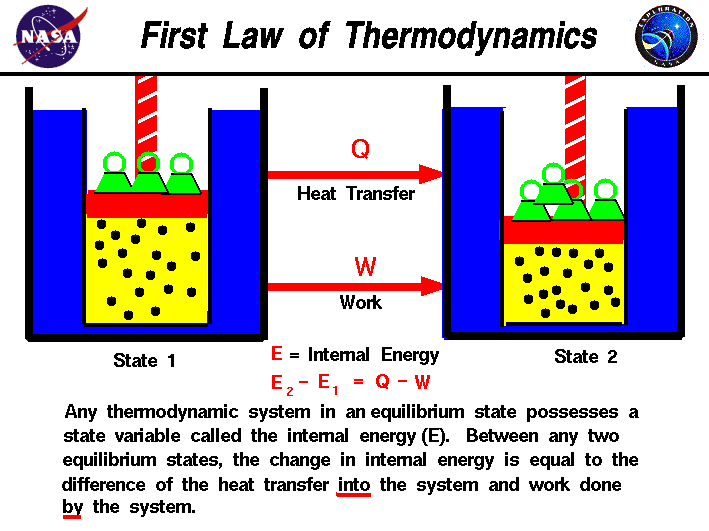
- The internal energy of a thermodynamic system is the energy contained within it. It is the energy necessary to create or prepare the system in any given internal state. It does not include the kinetic energy of motion of the system as a whole, nor the potential energy of the system as a whole due to external force fields, including the energy of displacement of the surroundings of the system.
- Example: The thermodynamic property of a system that changes by an amount equal to the work done on the system when it suffers an adiabatic change. It is the sum of the kinetic and potential energies of its constituent atoms, molecules, etc
- es: Energía interna
- Thermal conductivity
- a measure of the ability of a substance to conduct heat, determined by the rate of heat flow normally through an area in the substance divided by the area and by minus the component of the temperature gradient in the direction of flow: measured in watts per metre per kelvin
- Example: The computer usualy use the thermal conductivity with the aire.
- es: Conducción térmica
- Thermal diffusivity
- In heat transfer analysis, thermal diffusivity is the thermal conductivity divided by density and specific heat capacity at constant pressure. It measures the rate of transfer of heat of a material from the hot end to the cold end.
- es: Difusividad térmica

- Thermal symmetry
- It is the number of boundary conditions that need to be specified in one direction is equal to the order of the differential equations in that direction.
- es: Simetría térmica

- Variable
- Something that is variable changes quite often, and there usually seems to be no fixed pattern to these changes.
- Example: The potassium content of foodstuffs is very variable.
